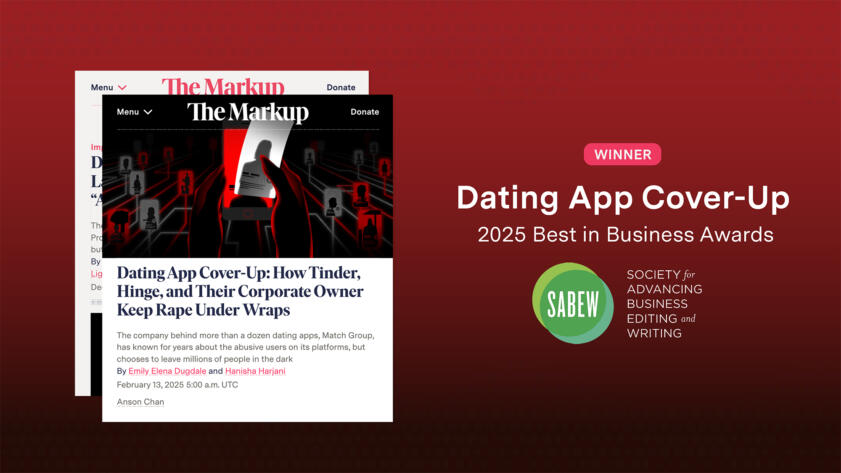
The Markup’s collaborative investigation “Dating App Cover-Up: How Tinder, Hinge, and Their Corporate Owner Keep Rape Under Wraps” has won in the Society for Advancing Business Editing and Writing’s 2025 Best in Business Awards. The story was produced in partnership with the Pulitzer Center’s AI Accountability Network and was copublished with The Guardian and The 19th.
The 18-month-long investigation about how Tinder, Hinge, and their corporate owner kept rape under wraps won in the technology category. The award recognizes excellence in digital journalism covering all aspects of technology, including culture, policy, and economic impact.

Dating App Cover-Up: How Tinder, Hinge, and Their Corporate Owner Keep Rape Under Wraps
The company behind more than a dozen dating apps, Match Group, has known for years about the abusive users on its platforms, but chooses to leave millions of people in the dark
Judges said that the collaborative investigation “draws readers into the dark hole of dating apps’ safety practices, along with how the industry’s dominant player turned a blind eye to the predators roaming its products. With urgency and moral clarity, reporters Emily Elena Dugdale and Hanisha Harjani shine a light on how an investor-pressured Match Group concealed accusations of sexual violence on its dating platforms.”
The Markup previously won four SABEW awards in the 2022 Best in Business Awards.
The most recent investigation is based on a review of hundreds of pages of internal company documents, thousands of pages of court records and securities filings, and dozens of interviews with company insiders and sexual violence survivors. In it, reporters Emily Elena Dugdale and Hanisha Harjani reveal that the Match Group, the world’s largest dating app company, had known about violence on its apps for years and failed to disclose that information with the public.
The investigation centers on a Denver cardiologist, who was sentenced to 158 years in prison after being convicted of drugging and/or sexually assaulting 11 women. We found Match Group was aware of his behavior for years — and yet he remained on its apps, swiping and assaulting.
Innovative product testing, led by statistical journalist Natasha Uzcátegui-Liggett, found banned Tinder users, including those reported for sexual assault, can easily rejoin or move to another Match Group dating app, all while keeping most key personal information the same.

Impact
Dating App Rape Survivors File Lawsuit Accusing Hinge, Tinder of “Accommodating Rapists”
The civil lawsuit filed Tuesday, citing the Dating App Reporting Project, argues that dating apps could kick off serial rapists, but don’t.
Ten months after the investigation, Uzcátegui-Liggett checked if the accounts created by The Markup in February, which had the same name, birthday, and profile photos of banned accounts, had been eventually banned by Match Group or its moderation systems. Every account checked was still in good standing.
The reporting team overcame many obstacles. Survivors were reluctant to speak, potential whistleblowers cited NDAs. In Colorado, a district court judge sought to prevent us from accessing critical records—including testimony from police officers and Tinder and Hinge messages read in open court.
In December, six women who were attacked by the cardiologist filed a lawsuit, accusing Match Group of “accommodating rapists across its products” through “negligence” and a “defective” product. The 54-page complaint extensively cites our investigation.
In California, state lawmakers said they are preparing legislation to reform the industry. On Feb. 20, 2026, Democratic state senator Caroline Menjivar introduced a bill that would require dating apps to conduct criminal background checks for California users.
Congratulations to all of this year’s SABEW Awards honorees.